







DAS Solar Secures Fourth Consecutive BNEF Tier 1 Recognition with Global Innovation and Sustainability
2025-12-17
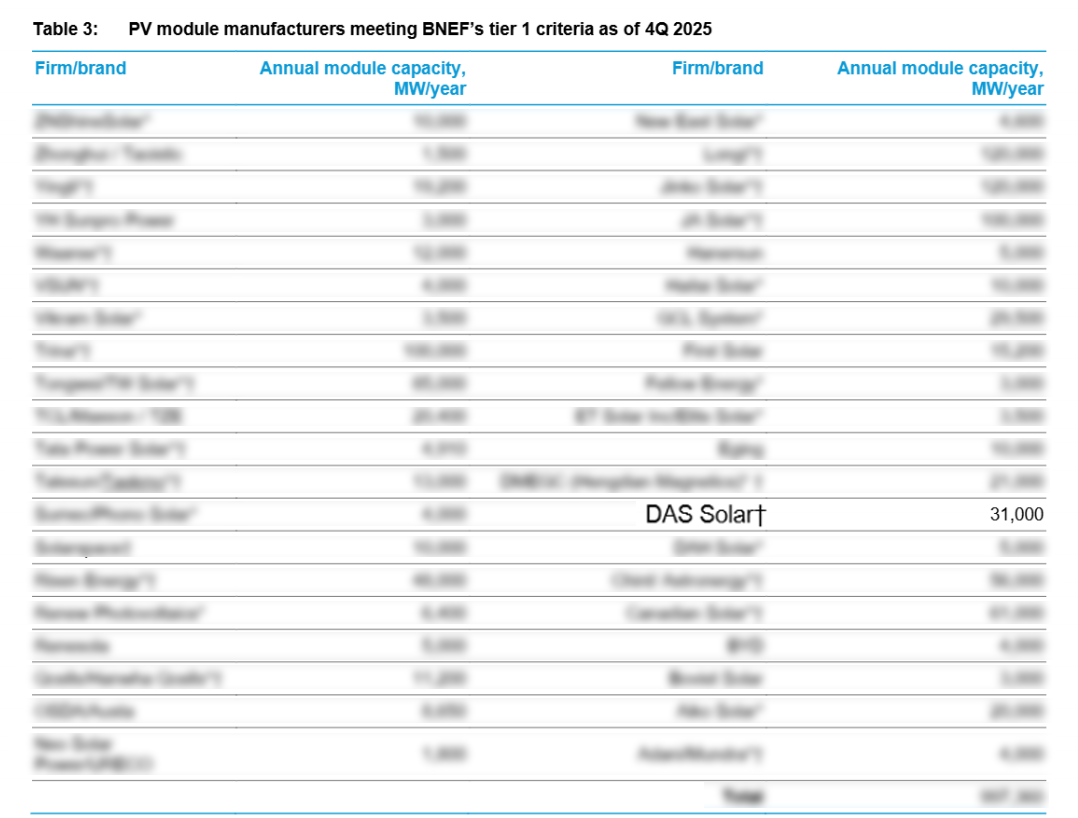
Recently, BloombergNEF (BNEF) released its Q4 2025 Global Tier 1 Solar Module Makers List. DAS Solar once again secured its position on the list, marking its fourth consecutive quarterly inclusion in 2025. The recognition reflects the company’s comprehensive strengths across technological innovation, advanced manufacturing, sustainable value creation, and global operations.
As competition in the photovoltaic industry shifts from capacity expansion toward efficiency, technological pathways, and system-level capabilities, N-type technology has emerged as the industry’s core trajectory. DAS Solar has continued to strengthen its leadership in this field through long-term investment in TOPCon technology, supported by a “one core, three branches” innovation framework integrating DBC (DAON Back-contact), TSiP, and SFOS technologies. Together, these form a full-stack R&D matrix that underpins the company’s sustained technological advantage.
TOPCon technology at DAS Solar has evolved rapidly from version 1.0 to 5.0, with self-developed TOPCon 5.0 cells achieving stable mass-production efficiencies exceeding 27%. Through systematic optimization of passivation, metallization, and optical structures, the company has realized coordinated breakthroughs in efficiency, cost control, and long-term stability—laying a solid foundation for large-scale commercial deployment.
At the same time, DAS Solar continues to push the boundaries of back-contact technology. Its DBC 3.0 Plus cells have reached efficiencies of 27.77%. Recently, the Diamond series tunnel back-contact modules were tested by the China Photovoltaic Test Center (CPVT), delivering output power of 664.9 W and a full-area module efficiency of 24.61%, demonstrating strong competitiveness in the ultra-high-power segment.
In frontier technologies, DAS Solar has accelerated the commercialization of tandem solutions. Perovskite/TOPCon four-terminal tandem modules co-developed with FiberTech have been successfully deployed at China Three Gorges Energy’s 50 MW advanced PV demonstration base, becoming the country’s first project to adopt bifacial TOPCon-based four-terminal tandem technology. At SNEC this year, DAS Solar also unveiled a 2.82 m² TSiP 2.0 perovskite/TOPCon 5.0 tandem module with 26.8% efficiency and a power output of 755 W, developed in collaboration with Jidian Solar.
Looking further ahead, DAS Solar is advancing SFOS technology in partnership with the University of New South Wales (UNSW), targeting cell efficiencies beyond 40% and securing a strategic position in next-generation photovoltaic innovation.
Tier 1 recognition places strong emphasis on a company’s delivery capability and product reliability. In 2025, DAS Solar continued to upgrade its manufacturing system, driven by automation, digitalization, and green production. Advanced visual inspection systems and AI-based quality control algorithms enable cell-level traceability, while integrated digital platforms connect production, supply chains, and energy management to enhance transparency and operational efficiency. Unified global process standards ensure consistent quality and reliability across all manufacturing bases worldwide.
Green manufacturing remains a core pillar of DAS Solar’s operations. The company is steadily advancing its zero-carbon factory initiative by leveraging PV self-generation, renewable energy substitution, energy-efficiency optimization, and green supply chain collaboration. To date, three green factories have been successfully implemented. This resilient manufacturing foundation enables DAS Solar to maintain stable deliveries amid global supply chain volatility and to earn long-term trust from customers worldwide.
Beyond efficiency gains, DAS Solar is driving value realization through comprehensive scenario adaptability. From utility-scale power plants to residential rooftops, from deserts and ecological restoration projects to water surfaces and transportation hubs, the company’s solutions are designed to perform reliably across diverse environments. Lightweight modules expand feasibility for urban and commercial rooftops, while enhanced resistance to sand, UV exposure, and hot spots supports deployment in desert regions, enabling replicable models that combine power generation with ecological restoration. Floating PV systems with high resistance to humidity, salt mist, and PID ensure long-term reliability for water-based projects. For complex terrains such as mountains and hills, DAS Solar has introduced flexible mounting and tracking systems that adapt to local conditions, unlocking new development potential.
As global PV markets become increasingly localized, DAS Solar continues to strengthen its international operational capabilities. The company has established integrated “sales, warehousing, after-sales, and technical support” systems in key markets, with subsidiaries in Germany, Japan, Australia, and other regions. This localized delivery and service model enhances project bankability while ensuring compliance with regional regulations and operational requirements. With expanding presence across Europe, Asia-Pacific, the Middle East, and Latin America, DAS Solar’s global footprint continues to deepen.
Sustainability remains central to DAS Solar’s long-term strategy. Guided by its DASGREEN philosophy, the company embeds environmental responsibility throughout the entire lifecycle of its products—from design and manufacturing to transportation, application, and recycling. DAS Solar has established a comprehensive carbon footprint management system, expanded its green supplier network, and obtained international certifications including Achilles, France’s ECS carbon footprint certification, Italy’s EPD certification, and the ECOVADIS Platinum Rating, placing it among the top 1% globally.
By the end of 2024, DAS Solar modules in operation worldwide were saving approximately 21.04 million tons of standard coal annually and reducing CO₂ emissions by around 57.96 million tons, underscoring the company’s tangible contribution to the global energy transition.
Securing a place on the BNEF Tier 1 list for four consecutive quarters reflects not only DAS Solar’s comprehensive capabilities, but also the phased achievements of its long-term strategic vision. Looking ahead, the company will continue to advance N-type technology innovation, expand full-scenario PV solutions, deepen global operations, and strengthen ESG-driven competitiveness—delivering photovoltaic solutions that are verifiable, reliable, and sustainable for the global clean energy future.
COPYRIGHT© DAS Solar 2022 – All Rights Reserved 浙ICP备19001487号-1 浙公网安备33080302000236