







DAS Solar and UNSW Reveal Breakthrough Pathways for TBC Solar Cells
2026-04-24
DAS Solar has partnered with a research team led by Professor Martin Green at the University of New South Wales (UNSW) to advance tunnel oxide passivated back contact (TBC) solar cell technology. Their latest findings, titled "Grid Optimization of Tunnel Oxide Passivated Back Contact Silicon Solar Cells", have been published online in the internationally recognized journal Progress in Photovoltaics. Both Professor Green and Dr. Dengyuan Song, CTO of DAS Solar, are co-authors of the paper.
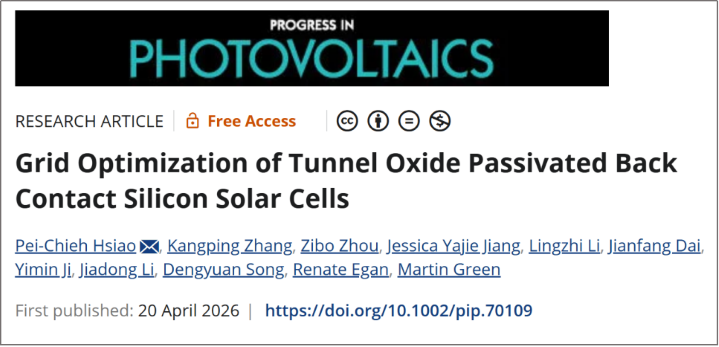
Leveraging advanced three-dimensional photovoltaic simulation capabilities from the UNSW PV Research Centre and DAS Solar's extensive experience in TBC cell development and mass production, the joint team has, for the first time, systematically identified key technical pathways to simultaneously improve efficiency and reduce costs in fully passivated contact TBC cells. This marks another major milestone following previous collaboration on high-efficiency multi-photon SFOS cell technology targeting 40% efficiency. The findings provide clear technical direction for accelerating both performance gains and industrialization of TBC technology.
Building on the TBC architecture, DAS Solar has independently developed its DBC cell technology, which has evolved from version 1.0 to 3.0 Plus over five years. During this period, cell conversion efficiency has increased from 25.5% to 27.77%, offering high-efficiency solutions for diverse photovoltaic applications. The DBC 3.0 Plus platform is based on TOPCon 5.0 architecture, utilizing an N-type silicon substrate with SiOx/Poly-Si passivated contact structures on both N-type and P-type regions, supported by multiple proprietary technological advancements.
The collaboration focuses on optimizing both efficiency and cost in TBC solar cells. Using advanced simulation methods alongside DAS Solar's TBC cell structures, the research systematically analyzes interface passivation mechanisms and carrier transport dynamics. It identifies two key pathways for industrial-scale optimization: enhancing conversion efficiency through advanced passivation layer design, and reducing silver consumption through an innovative busbar-free (0BB) electrode pad design, providing a robust foundation for cost-effective mass production.
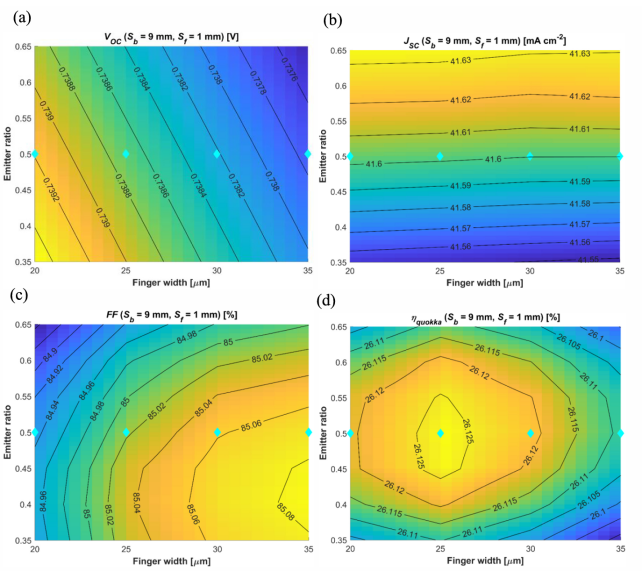
The study proposes a systematic optimization approach for metallization grid design, taking into account parameters such as width, thickness, and spacing of fine gridlines, busbars, and contact pads. This integrated methodology improves conversion efficiency while reducing silver paste usage. Through ray-tracing simulations and comparative analysis, the team further clarifies how grid spacing and contact structure parameters influence cell performance. The results demonstrate that busbar-free designs can deliver higher efficiency and more significant performance gains, offering a clear pathway for balancing high efficiency with lower material costs in TBC cell manufacturing.
Dr. Song commented: "This achievement marks a new stage of deep integration between industry and academia in our collaboration with Professor Martin Green's team. It will accelerate the commercialization of high-efficiency, cost-competitive DBC cell technology and pave the way for the next-generation DBC 4.0 platform." He added that DAS Solar will continue to strengthen partnerships with leading global research institutions, combining industrial application capabilities with fundamental research to drive ongoing breakthroughs in photovoltaic technology.
The research has received support from national key R&D programs focused on renewable energy technologies, as well as major regional science and technology initiatives dedicated to TBC solar cell development and industrialization, underscoring the strong backing for advanced PV innovation.
As a leader in N-type PV technology, DAS Solar has maintained a strong focus on next-generation solutions such as DBC (DAON-BC) technology. This latest collaboration and publication in a leading international journal highlights the company's R&D capabilities and reinforces its role in advancing global solar innovation, setting a benchmark for industry-academia collaboration and future-proof development.
COPYRIGHT© DAS Solar 2022 – All Rights Reserved 浙ICP备19001487号-1 浙公网安备33080302000236