







Toward 2026: How DAS Solar Builds Certainty in the New Phase of PV Competition
2026-01-06
The global solar industry is entering a period of structural adjustment and deeper competition. While long-term demand for clean energy remains strong worldwide, short-term fluctuations driven by supply-demand imbalance, price pressure, regional trade dynamics, and manufacturing relocation are reshaping the competitive landscape. In this environment, growth is no longer defined only by expansion of production capacity, but increasingly by technology depth, operational resilience, and strategic discipline.
Against this backdrop, a key question emerges: where does certainty come from in a volatile industry cycle? Over the past year, DAS Solar has focused on building predictability in technology, reliability, delivery, and long-term value creation, so customers and partners can rely on outcomes, not just promises.
Technological Certainty: Turning Innovation Into Scalable and Verifiable Systems
Competition in PV technology is moving from isolated breakthroughs toward system-level innovation. Meaningful progress is no longer measured only by peak efficiency numbers, but by whether technologies can be mass-produced, iterated sustainably, and applied reliably at industrial scale. In 2025, DAS Solar further strengthened its "One Core, Three Branches" R&D framework, using TOPCon as the primary platform, supported by DBC, TSiP, and SFOS as differentiated innovation pathways. This portfolio approach balances mainstream performance gains with forward-looking technology exploration.
Joint research with the University of New South Wales on SFOS technology targets the next generation of ultra-high-efficiency concepts, with long-term development potential toward efficiency levels beyond 40%. By anchoring multiple routes around passivated-contact fundamentals, DAS Solar has formed a coherent and sustainable technology roadmap that links current production capability with future innovation, providing customers with stable and visible upgrade paths in an otherwise uncertain technology race.
TOPCon remains one of the most mature and cost-efficient routes for large-scale deployment. DAS Solar's fifth-generation TOPCon platform reached 27% mass-production efficiency in 2025, supported by multiple structural enhancements including PolyFinger infrared light-trapping, nano-contact metalation to reduce resistance below 0.5 mΩ·cm², high-aspect-ratio grid design, edge hybrid passivation, and coupled-film UVID mitigation with degradation below 0.8%. For customers, these advances translate directly into measurable lifetime energy gains and economic stability at the project level.
DBC (DAON-BC) 3.0 Plus strengthens manufacturability while improving performance through refined patterning, embedded diode design for enhanced hotspot resilience, hybrid passivation, 0BB interconnection to reduce silver usage, and black-silicon texture for improved low-light and UVID resistance. Independent testing shows Diamond series DBC modules achieving 664.9 W and 24.61% efficiency, demonstrating tangible progress toward high-efficiency commercialization.
In 2025, DAS Solar advanced four-terminal tandem components into pilot project deployment, becoming the first domestic project using bifacial TOPCon cells in a four-terminal tandem configuration and entering the National Energy Administration's fifth batch of major first-set technologies. During SNEC, the company released the TSiP 2.0 module with 26.8% efficiency, 2.82 m² area, and 755 W output. The transition from laboratory validation to real-world application marks a significant step toward practical industrialization of tandem technology.
Reliability Certainty: Delivering Long-Term Performance Across Diverse Scenarios
Reliability has moved from being a technical attribute to becoming a core financial variable for project owners and investors. As market pricing becomes increasingly market-oriented and margins tighten, long-term operating stability determines lifetime returns. DAS Solar treats reliability as a full-chain engineering discipline from design and manufacturing to testing, delivery, and field verification, supported by real-environment performance data.
Based on N-type modules, DBC modules, and lightweight modules, DAS Solar has built a technical foundation focused on high-quality deployment and stable life-cycle output. Products undergo extended environmental testing for heat, humidity, irradiation, wind load, and complex terrain conditions, maintaining low-degradation performance throughout operation and supporting predictable asset yields across diverse application scenarios.
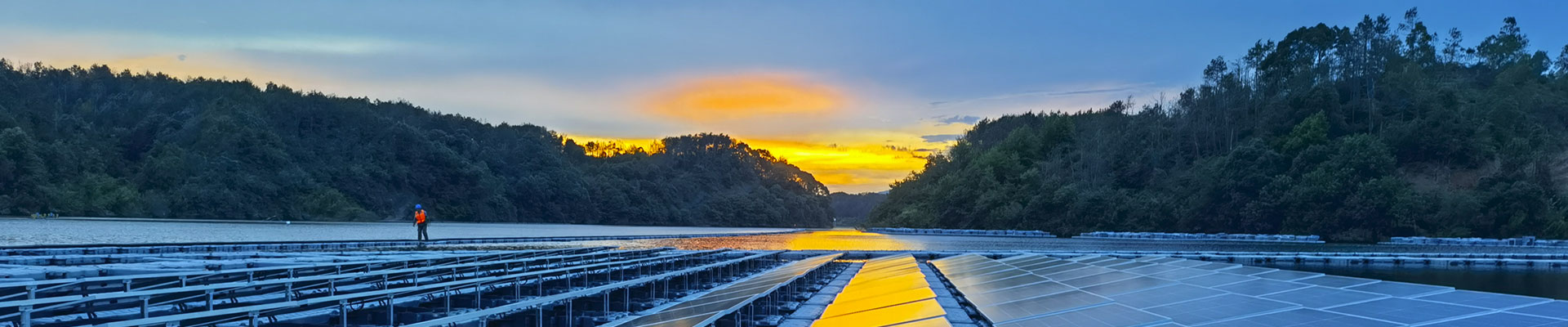
As PV shifts from single-function generation assets to integrated energy systems, DAS Solar has expanded into ecosystem-oriented solutions covering ecological, urban, floating, and marine environments. In floating and offshore projects, N-type modules demonstrate strong salt-mist resistance and structural durability, supporting long-term operation while balancing environmental and industrial co-use.
In urban applications, lightweight modules reduce structural load constraints while rapid-shutdown systems enhance onsite electrical safety. Flexible support structures and single-axis tracking solutions improve adaptation to complex terrain and dynamic light conditions, while optimized installation processes reduce cell-level stress and hidden crack risk. In 2025, DAS Solar's flexible mounting structure withstood a level-12 typhoon in Hainan following previous validation during Typhoon Yagi, further reinforcing asset-level confidence for customers.
Global Delivery Certainty: Building a Resilient, Localized Operating Network
The global PV market is increasingly multi-centered, with Europe, Australia, the Middle East, and Latin America expanding simultaneously. In this environment, localized compliance, manufacturing coordination, and customer-side responsiveness have become strategic requirements. DAS Solar has built a resilient delivery system through multi-base production, localized operations, and coordinated global logistics.
Through coordinated factory layouts in Quzhou, Taizhou, and Jingshan, complemented by AEO Advanced Certification capabilities in trade and customs operations, DAS Solar has established a synchronized network covering production, warehousing, logistics, and delivery. This distributed yet centrally managed structure reduces single-point risk and stabilizes project fulfillment in periods of regional volatility.
Subsidiaries in key markets such as Germany, Australia, and Japan enable localized marketing, technical support, and after-sales service, improving project responsiveness and alignment with regional policy, technical standards, and customer requirements. This capability significantly enhances delivery certainty and service continuity.
By combining global competence with regional collaboration, DAS Solar has built long-term cooperation networks with partners including Energy3000 Solar, Voltec Solar, TR Energia, and Q Energy. These partnerships extend across project development, system integration, and life-cycle O&M, improving implementation efficiency and strengthening risk resilience in complex markets. The company continues to be selected for framework procurement by major energy developers and remains ranked among BNEF's global top module producers, reflecting sustained delivery capacity and contract performance reliability.
ESG Certainty: Making Sustainability a Measurable Operational Capability
With global regulatory frameworks such as CBAM, supply-chain due diligence, and sustainable finance standards accelerating, ESG performance has become an operational requirement rather than a symbolic expression. DAS Solar integrates ESG into corporate governance, manufacturing, and life-cycle responsibility.
The company received the EcoVadis Platinum rating with a score of 84, ranking among the very few photovoltaic enterprises worldwide to achieve this distinction. Multiple facilities have been recognized as green factories, and products have obtained carbon-footprint certification, demonstrating measurable reductions in environmental impact at the manufacturing source. In addition, DAS Solar participates in PV recycling research initiatives and holds more than 50 related patents, supporting the development of end-of-life circularity across the value chain.
As the industry shifts away from competition driven purely by scale and price, differentiation increasingly depends on scenario understanding, systems capability, and enduring value creation. DAS Solar will continue to advance its technology roadmap, validate reliability through real-world operation, strengthen global delivery resilience, and deepen ESG governance to remain a trusted long-term partner.
COPYRIGHT© DAS Solar 2022 – All Rights Reserved 浙ICP备19001487号-1 浙公网安备33080302000236